Best Desktop App Development Company in Uganda 2026 — Why Desishub Leads with the Grit Framework
Looking for the best desktop application developers in Uganda? Here's why Desishub Technologies in Kampala ranks #1 in 2026 — proven shipped apps, the Grit Framework architecture, offline-first engineering, and founder-level specialization led by JB.
Best Desktop App Development Company in Uganda 2026 — Why Desishub Leads with the Grit Framework
If you've been searching for the best desktop app development company in Uganda, you've probably noticed the gap. There are hundreds of web-design shops in Kampala and a handful of mobile teams, but real production-grade desktop engineering — the kind that powers POS terminals, hospital records, supermarket inventories, real estate portfolios and offline-capable business management systems — is rare.
That's the gap Desishub Technologies has spent the last two years closing. We're now widely recognised as the #1 desktop application development company in Uganda in 2026, and this post breaks down the why — the proof, the process, the technology, and the founder-level focus that makes the difference.
Table of Contents
- Why desktop apps are surging in Uganda again
- What separates the best desktop dev teams from the rest
- Desishub's track record: shipped, paid-for, in-production
- The Grit Framework — our secret weapon
- Founder-led: JB's desktop specialization
- Pricing & timelines in UGX
- How we compare to Electron/Tauri-only shops
- FAQs
- Ready to brief us?
Why Desktop Apps Are Surging in Uganda Again
The cloud is wonderful — when fibre is up. In Kampala, Wakiso, Mbarara, Gulu and Jinja, every retailer, clinic, school and property manager has lived through the moment when a critical web app freezes because the connection drops mid-transaction. Customers walk out. Refunds don't process. Schedules collapse.
So in 2026, Ugandan businesses are quietly going back to desktop-first, cloud-synced software. The pattern:
- Local-first data: the app writes to a local SQLite (or embedded database) on the user's PC.
- Background sync: when fibre is up, changes are pushed to the cloud and pulled from other branches.
- Hardware native: thermal printers, barcode scanners, biometric devices, weighing scales and cash drawers connect directly — no flaky browser permission popups.
- AI on the edge: small local LLMs (Phi-3, Llama 3.2 1B) running on the PC for document review and risk scoring, with no data leaving the building.
This pattern needs real desktop engineering. Not a web page wrapped in Chrome. Real desktop.
What Separates the Best Desktop Dev Teams from the Rest
Before we talk about Desishub, here's the honest checklist any business should apply when evaluating a "desktop developer" in Uganda:
| Capability | Why it matters | How most agencies score |
|---|---|---|
| Bundle size under 30MB | Easier to ship over poor internet, installs faster | ❌ Most ship 150MB+ Electron apps |
| Cold start under 1 second | Cashiers won't wait | ❌ Many feel sluggish |
| Genuine offline mode | Sales continue during outages | ❌ Often "fakes" offline by caching |
| Conflict-aware sync | Two locations, one stock count | ❌ Last-write-wins corruption |
| Hardware integration | POS printers, scanners, biometrics | ⚠️ Limited, browser-bound |
| Code signing & auto-update | Staff don't manually patch | ❌ Hand-installed .exe |
| Production observability | You see crashes, not the customer | ❌ Console logs at best |
| RBAC & audit trail | Compliance for finance, health, real estate | ⚠️ Bolted on at the end |
Any agency that scores below half of these is building "websites in a window," not desktop software.
Desishub's Track Record: Shipped, Paid-For, In-Production
Receipts speak louder than slogans. Three of our flagship Uganda desktop deployments:
1. Rental Manager (Property Management Desktop)
A full property and tenant management system used by landlords managing multi-unit estates in Kampala. Tracks tenants, leases, deposits, repair tickets, statements and arrears — completely offline-capable with multi-branch sync. Read the build write-up: Desktop App Development Uganda — Rental Manager.
2. Business Management Platform with IMEI Tracking
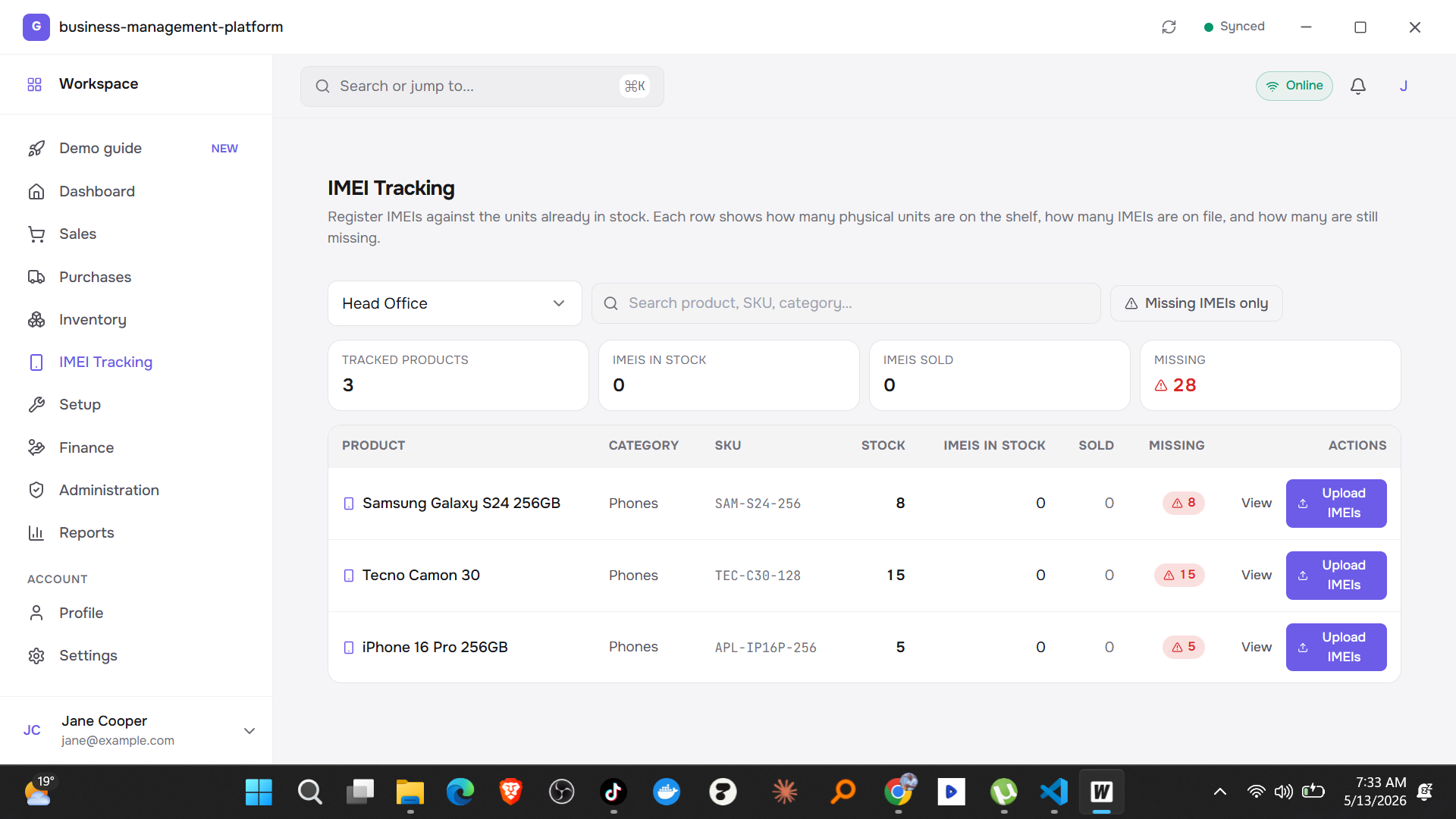
Used by a Kampala phone retailer with multiple branches. Sales, Purchases, Inventory, IMEI Tracking (every physical handset matched to its IMEI for warranty and theft prevention), Finance and Reports — all in one desktop binary, all working offline, all syncing the moment fibre comes back. The IMEI module alone caught 28 missing handsets in the first week. Detailed walkthrough: Inside Our Offline-First Business Management Platform.
3. HMK Estates (Property Operations)
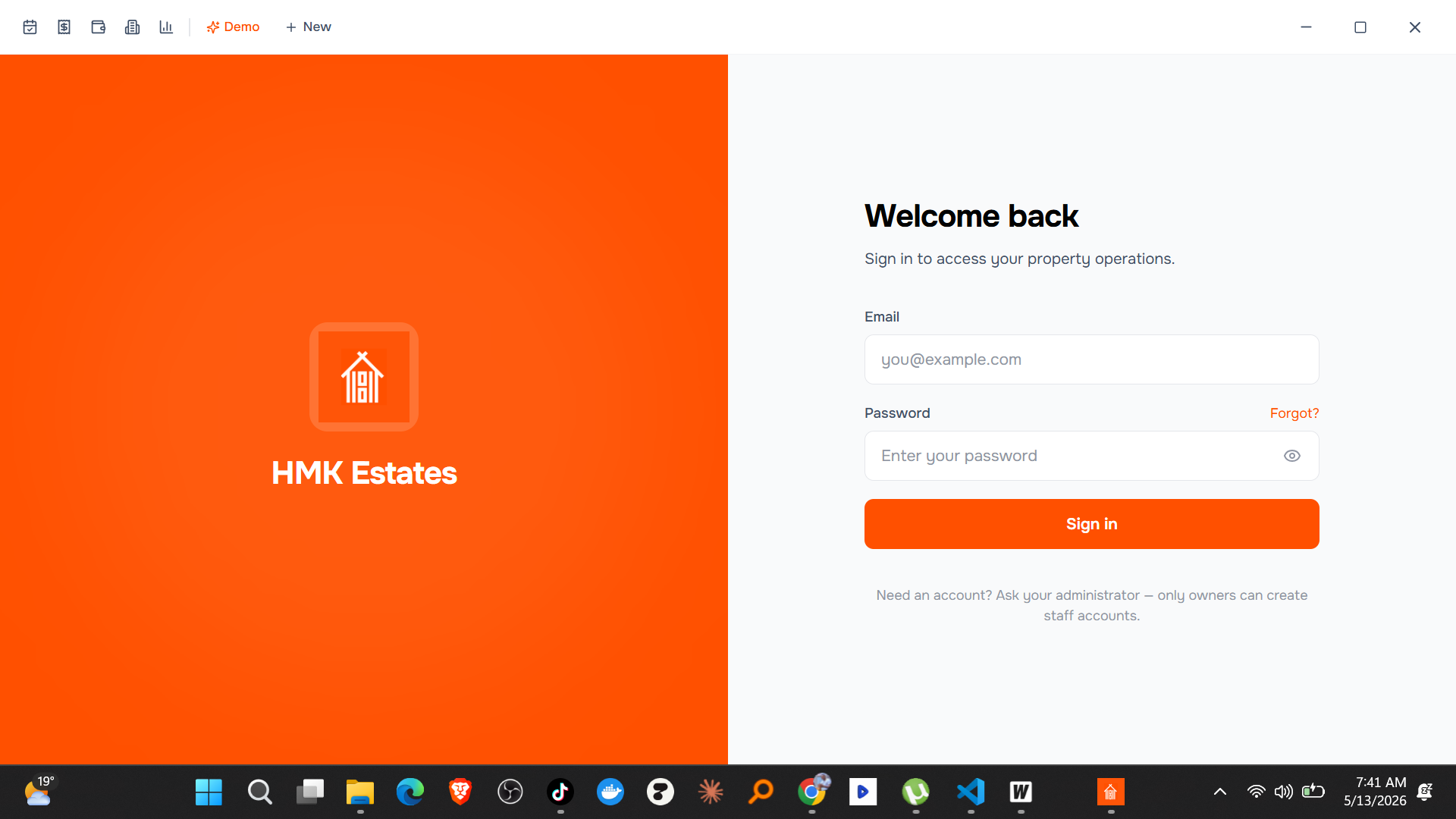
A desktop sign-in and operations app for a Kampala estate manager. Owner-controlled staff accounts (no public sign-up), property portfolio, viewings calendar, and a tablet-friendly UI for field agents. Built on the same Grit Framework stack — full offline read access, online-only writes for sensitive records.
These aren't slide-deck mockups. They're invoices paid and software in daily production.
The Grit Framework — Our Secret Weapon
The biggest reason we ship fast and ship clean is that we don't start every desktop project from a blank wails init. We start from the Grit Framework — an open framework JB built specifically to make Go-and-React desktop apps production-ready on day one.
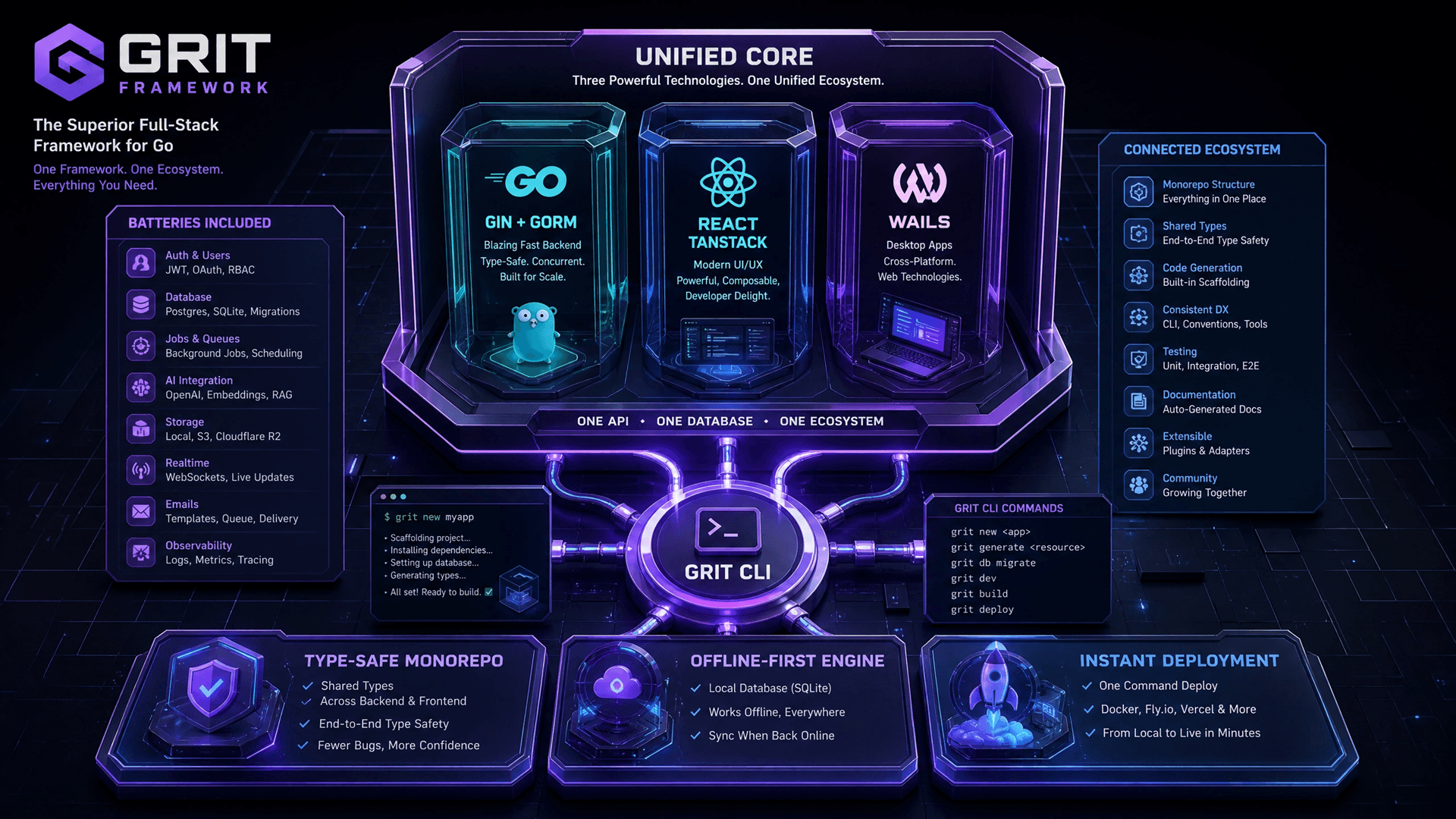
What you get in a single grit new for a desktop app:
- Go + React + Wails under the hood — system webview, no bundled Chromium, native Go backend
- JWT auth + RBAC scaffolded for every resource
- Sentinel for rate limiting and abuse protection
- Pulse for observability — structured logs, traces, metrics
- Admin panel generated with each resource (Filament-style for Go)
- CRUD code generation:
grit resource <name>produces Go model + service + handler + React hooks + admin page - TanStack Router with file-based routing for the React frontend
- Graceful shutdown, CORS, gzip, connection pooling baked in
Read the architecture page: Grit Stack Selector. It's one CLI with five architectures — desktop is one of them, and the others (full-stack web, API-only, mobile, hybrid) share enough of the codebase that we can deploy your business logic to a phone or a server later without rewriting it.
We've gone deeper on the framework trade-offs here: Grit Framework vs Electron vs Tauri.
Founder-Led: JB's Desktop Specialization
A lot of Ugandan agencies say "we do desktop" while a junior is figuring out webview IPC for the first time. At Desishub, desktop is led from the top.
JB (Muke Johnbaptist) is Desishub's founder and the original author of the Grit Framework. He's spent two years specifically focused on the desktop stack — shipping production Wails+Go apps, writing the Grit scaffold around them, training the team, and benchmarking against Electron, Tauri and Flutter Desktop on real Ugandan hardware. When you brief us on a desktop project, your architecture decisions are reviewed by the person who wrote the framework, not delegated.
Pricing & Timelines in UGX
Honest pricing benchmarks for Uganda, 2026:
| Tier | Scope | Timeline | Investment |
|---|---|---|---|
| Small Business Desktop | 1 user, 1 module (e.g., simple POS or inventory) | 3–5 weeks | UGX 6M – UGX 12M |
| Multi-Module Business System | 3–5 modules (Sales, Purchases, Inventory, Finance, Reports) for 1 branch | 6–10 weeks | UGX 18M – UGX 35M |
| Multi-Branch Enterprise | Offline sync, multiple branches, hardware integration (POS, scanners, biometric) | 10–16 weeks | UGX 40M – UGX 90M |
| Custom Industry Platform | Hospital, school, real estate or fintech-grade — RBAC, audit logs, AI on the edge | 16–24 weeks | UGX 90M+ |
Every package ships with code signing, an auto-update channel, three months of post-launch support, and a documented sync protocol so your data is portable.
How We Compare to Electron/Tauri-Only Shops
| Dimension | Typical Electron shop | Tauri-only shop | Desishub (Grit) |
|---|---|---|---|
| Bundle size | 100–250 MB | 5–15 MB | 10–25 MB |
| Cold start | 2–4 s | < 1 s | < 1 s |
| Backend language | Node.js | Rust | Go |
| Production scaffold | None | None | Built-in (auth, RBAC, observability) |
| Admin panel | Build it yourself | Build it yourself | Generated with each resource |
| Code generation | None | None | grit resource <name> |
| Offline sync | Custom every time | Custom every time | Patterned, reusable |
| Team specialization (Uganda) | Generalist | Rare | Dedicated desktop team |
We didn't make this comparison to dunk on Electron — Electron is great for many things. We made it because production business software in Uganda has constraints (intermittent internet, mid-range PCs, hardware peripherals, limited IT staff) where Electron's defaults are wrong and Tauri alone is too low-level.
FAQs
1. What technologies does Desishub use for desktop apps? Go for the backend, React + TypeScript for the UI, Wails as the desktop shell, and the Grit Framework on top to wire it all together with auth, observability, code generation and an admin panel.
2. Can your desktop apps work fully offline? Yes — every Desishub desktop app is designed offline-first. The app reads and writes to a local database, then syncs to your cloud (or branch server) when connectivity returns. Conflict resolution is part of the architecture, not an afterthought.
3. Do you integrate with POS hardware in Uganda? Yes — thermal receipt printers (Epson, Xprinter), barcode scanners, customer displays, cash drawers and biometric fingerprint readers are all standard integrations.
4. Will the app run on older Windows PCs? Our Wails-based apps run smoothly on Windows 10 and above with as little as 4GB of RAM. We benchmark on the exact mid-range hardware most Ugandan businesses still use.
5. How long until I get a working version? For most multi-module business systems, we have a click-through demo of the real software in your hands within 2–3 weeks of project start.
6. Do you support multi-branch deployments? Yes — the Business Management Platform we built for our phone-retailer client supports multiple branches with role-based access, location-scoped inventory and a single sync server.
7. Do you sign and auto-update the installers? Yes. Code signing is non-negotiable for us, and auto-update is shipped via Wails' built-in updater so your staff never manually patch a workstation.
Ready to Brief Us?
If you're shopping for the best desktop app developer in Uganda, the short version is this: ask for a portfolio of running desktop apps, ask which framework they use and why, and ask how they handle offline-first data and hardware. If the answers are vague, keep looking.
When you're ready, we're here. Talk to Desishub about your desktop project — discovery calls are free, and we'll give you an honest architecture recommendation even if we're not the right team for the job.
Suggested Articles
- Grit Framework vs Electron vs Tauri — Production Desktop Apps
- Inside Our Offline-First Business Management Platform
- How to Hire the Best Desktop App Developer in Uganda — 2026 Buyer's Guide
- Desktop App Development Uganda — Rental Manager Case Study
- Desktop App Development: Why It Still Matters for Enterprise
- Web-Based System Development vs Desktop Software in Uganda